Tampilkan postingan dengan label Vishesh Bhriguvanshi. Tampilkan semua postingan

Rabu, 12 Oktober 2011

India wins double gold at South Asian Beach Games 3x3 Basketball in Sri Lanka


It was double success for India’s 3-on-3 (3x3) basketball teams at the 1st South Asian Beach Games (SABG) in Hambantota, Sri Lanka, on Tuesday, as both the Indian Men and Women won the gold medal after defeating Sri Lanka and Maldives in their respective finals. Both of India’s basketball squads finished the three-day competition undefeated, with 4-0 records.

Although real Beach Basketball is played on sand, the competition at the SABG showcased an outdoor version of the 3x3 basketball format, a modified version of the game which is played in the half-court. Each team is allowed just three players on the court and the 10-minute game can only go up to a maximum of 21 points.

In the Men’s final, Sri Lanka took a confident start, but India quickly fought back and held on to a three point lead at halftime. Behind eight points by Jagdeep Singh, India extended their lead to clinch the win, 21-16.

Earlier, on Sunday and Monday, India’s Men’s side had won all three of their group games, defeating Maldives, Bhutan, and Sri Lanka.

India also dominated the women’s final, defeating Maldives by 17-7 on Tuesday evening. India’s Women’s side had also won all their earlier games on the previous two days, defeating Nepal, Maldives and Sri Lanka.

Final Standings

Men

1. India
2. Sri Lanka
3. Maldives

Women

1. India
2. Maldives
3. Sri Lanka

Minggu, 25 September 2011

2011 FIBA ABC Review: China win final over Jordan; India end 14th


Oh, it was all good just a few weeks ago. In India's first game at the 2011 FIBA Asia Basketball Championship, we held a seven point lead in the final quarter over Lebanon, a team ranked 26 places above us in the FIBA world rankings. We ended up losing that game, by the way, and then, losing everything else that came in our way. A week later, our campaign ended with a loss to Indonesia as we finished the championship at 14th place. That was a depressing finish to my cautiously optimistic hopes before the tournament. Now, the tournament is over, and after weeks of unpredictable and exciting basketball, there is a familiar name at the top of the rankings.

In front of an electric crowd in Wuhan, hosts China rose to the top of FIBA Asia after a silver medal two years ago by edging out the tough Jordan side 70-69 in a classic final of the championship on Sunday. Led by tournament MVP Yi Jianlian, China claimed the gold medal and booked their place in the 2012 Olympic Games basketball tournament in London.

The final win was a culmination of a perfect 9-0 record in the competition. China lifted the FIBA ABC trophy for the 15th time.

Jordan walked out of the arena with their heads held high having entered the gold medal game for the first time. Jordan did extremely well beyond expectations to keep the contest even till the final buzzer. Despite finishing 2nd in their preliminary round group, and fourth in the second round group, Jordan did the impossible by defeating last year's champs Iran in a classic Quarter Final and then getting a win over a strong Philippines side in the Semis.

For China, Yi accounted for 11 of his team-high 25 points in the third quarter. Yi also had 16 points in the final. Yi continues to confound me, as he is such a dominant force back home but a super-flop in the NBA. Supposed to be China's next big thing after Yao, Yi has bounced around 3 NBA teams in the past four years, and has put up just 8.5 ppg in the course of his career, where he has never been able to earn major NBA minutes. He had his worst year with the Wizards last season, playing only 17.7 minutes a game and putting up just 5.6 ppg. He comes back home and completely DOMINATES Asia, averaging 16.6 ppg and 10.8 rpg as MVP of the championship.

Rasheim Wright was at the vanguard of the Jordanian cause in the Final with a game-high 26 points.

Earlier on Sunday, the 3rd/4th place match-up between Korea and Philippines was also a nail biting affair, won by Korea 70-68. Sungmin Cho led the way for Korea with 20 points. The high-scorers for Philippines were Marcus Douthit (27) and Jim Alapag (17).

Final Standings:

  • 1. China
  • 2. Jordan
  • 3. Korea
  • 4. Philippines
  • 5. Iran

    All Tournament Team:

  • PG: Osama Daghles (Jordan)
  • SG: Takuya Kawamura (Japan)
  • SF: Samad Nikkah Bahrami (Iran)
  • PF: Yi Jianlian (China) - MVP
  • C: Hamed Haddadi (Iran)

    Meanwhile, the Indian contingent completed the tournament with a 1-4 record to end at 14th place. That record is misleading, by the way, because India didn't exactly 'win' a single game at the tournament: we were handed a victory in our 13-16 classification game over Qatar without even playing them. Qatar were made to forfeit their games after their players 'deliberately lost' a couple of earlier games after five of their players were disqualified without proper nationality documentation.

    And we started off as well as we possibly could! Grouped with tough Lebanon and Korea, and with Malaysia, a team we were expected to beat, India needed just one win to move on to the next round. India played without a consistent starting lineup: Vishesh Bhriguvanshi, Jagdeep Singh, and Yadwinder Singh were our regular starters, and the other two places were rotated between Hareesh Koroth, TJ Sahi, and Trideep Rai.

    We almost got our one win unexpectedly, against Lebanon. After trailing by 13 at the end of halftime, India went on an epic third quarter run, perhaps the finest quarter of basketball played by the Indian men's team in recent history, as they outscored the superpower Lebanon 32-14 behind a barrage of three and two pointers by Hareesh Koroth and TJ Sahi.

    Less than two minutes away from the final buzzer, India held a one-point lead and were on the verge of making history. But a heroic performance by Lebanon's Jean Abd El Nour denied India its chance at history, as Lebanon survived to win 71-68. El Nour scored eight of his game-high 24 points in the dying minutes of the game to defeat the enthusiastic Indian outfit.

    Hareesh Koroth had 20 points for India and TJ Sahi added 18.

    The game against Malaysia the next night was to be our make or break game: we are ranked much higher than them, and if we had won, we would've immediately improved to our 13th place ranking from 2009 and had a chance to move into the final 12. But an end game burst by Malaysia saw them emerge as 71-67 winners and virtually clinched their place in the second round, giving India another last-minute heartbreak.

    The game swung back and forth like a pendulum: India fell back once again at halftime in this match-up trailing to their opponents by 16 points at the break. But once again, India showed their third-quarter resolve, outscoring Malaysia 24-12 in the period and bringing the game close again. The fourth quarter see-sawed between both the sides, and with the game tied in the final minutes, lower-ranked Malaysia made a final run to edge out a close win.

    Malaysia were led by Ban Sin Ooi, who scored 20 points in the game, although the game's best individual performance came from India's experienced big man Jagdeep Singh Bains, who had a heroic 25 points and 11 rebounds in the loss.

    We were never expected to challenge Korea in our final group game, and we didn't: Korea scored the first eight points of the game and only grew in strength thereafter before romping through for a 84-53 win against India on Saturday to complete their Group A engagements with an all-win record. It was India's third consecutive loss in the tournament, which saw them finish at the bottom of the group and eliminated from the second round.

    Trideep Rai’s 11 points was the only double digit score for India. Despite the disappointment, coach Natt looked at the positives after the game and commented: "We have a long way in terms of going anywhere in Asian competitions. But I think we are making a start with this young team."

    Out of the Second Round and forced to settle for 13-16 qualification, India got a lucky break when we were handed a 20-0 win against Qatar because of the forfeit. We played Indonesia in the 13/14th place match, a team that, with all of our revamped efforts we should've defeated. But like our effort against Malaysia earlier, we once again came up short. India trailed most of the way in the competitive game and failed to close the gap between the two sides, as Indonesia won 84-75.

    India’s sharp-shooter Hareesh Koroth continued his bright showing at the championship, with 22 points off the bench to lead all scorers in the game. India were close the whole game, and trailed by just seven points at halftime. Indonesia continued to slowly extend their lead, and a decent fourth quarter by the Indian side was a little too late to prevent the loss.

    This tournament was the first large scale international exposure for the Indian team under new NBA coach Kenny Natt. Despite the low ranking, India showed flashes of their potential under the new coach, highlighted with the near-upset of Lebanon in their first game. It's tough to say why we under-performed against Malaysia and Indonesia, but perhaps the near-slaying of the giants Lebanon, and the eventual loss, may have been crushed the players' spirits a bit.

    This tournament also gave the chance to several young Indian players to gain valuable experience, and the likes of Amjyot Singh and Amrit Pal Singh stepped up to make their contributions to the squad. Amjyot is the one player who really excites me for the future: playing limited minutes of the bench, Amjyot led India in rebounding (7.3 rpg) and had several important hustle points. Amjyot also averaged 1.8 blocks per game, good enough for second-place in the tournament, only to Iran's Hamed Haddadi, who plays for the Memphis Grizzlies!

    With 1.8 steals per game, India's TJ Sahi finished at joint first place with Sun Yue (China), Osama Daghles (Jordan), and Ibrahim Ahmad (UAE) in steals average.

    Our best player was Hareesh Koroth, who led the team in scoring (15.3 ppg) and was our only consistent scoring threat. Jagdeep Singh played pretty well, too, averaging 12.5 ppg and 6.0 rpg in the championship.

    The biggest disappointment was Vishesh Bhriguvanshi, our former captain and a personal favourite of mine. Playing major minutes, and usually, a major offensive force, Vishesh had 17 points TOTAL in the tournament, averaging just 4.3 points per game shooting an awful 16 perfect from the field. Ugh!

    All the stats above, by the way, were compiled by Siddharth Sharma for SportsKeeda.

    At the end, our ranking actually fell one place from 13th to 14th this year. So, where do we go from here? I made a note in a post last week about India's glaring weakness - the point guard position - and Coach Kenny Natt's desperate need to find a consistent general to lead our side. Beyond that, the future doesn't look too bad for us, actually. This tournament ended on a sad note, but we have a *very* young squad who will only get stronger with this experience. I am talking about our young under 20 bigs Amjyot and Amrit Pal who are on a fast-track to improvement. And of course there's 15 year old Satnam Singh Bhamara, who got limited minutes in the tournament but will be better off with the exposure of this big stage.

    Natt had only a few months with this team to not only raise the talent level of the players at hand, but to also attempt to change the culture and improve the system of hoops in India. With this championship over, he now has two more years until the next one, two more years to train the future crop of Indian players, and to help us make that long-awaited 'baby step' improvement on the international stage.

    Congrats for the win China; and India will be looking forward to 2013.
  • Rabu, 21 September 2011

    Start dribbling kids; India needs a point guard


    When I was younger, one of my favourite movies was the Michael Jordan/Bugs Bunny starrer Space Jam (Unshameful disclosure: it still is one of my favourites, actually). What I loved almost as much as the movie though was the soundtrack. Chris Rock and Barry White captured it best when speaking about the emotions of a young wannabe basketball star in 'Basketball Jones'.

    Then one day, my mama bought me a basketball
    And I loved that basketball
    I took that basketball with me everywhere I went
    That basketball was like a basketball to me
    I even put that basketball underneath my pillow
    Maybe that's why I can't sleep at night


    Aah. How I wish to see the day when hundreds and thousands of young kids in India will grow up with the 'Jones'. When they fall in love with a basketball as much as they love the cricket bat. When they keep dribbling, day and night, so that the by the time they grow up the basketball becomes an extension to their own body.

    No position on the basketball court has more of a 'basketball-an-extension-to-the-body' feel than the point guard. The PG spends (or should spent) more time than any other player on the court with the basketball in their hands, and in my opinion, clearly is the most important guy on the court.

    Point guards are in fashion, aren't they; well at least, in the NBA world they are. Derrick Rose won the MVP award and made it possible for a point guard, for the smallest man on the court, to be a volume scorer and be in a fantastic winning team. Iverson of course did it first, but he was never strictly a PG; the likes of Eric Snow were deputised to bring the ball up for him and them let him go ballistic.

    Where am I going with this? Well, a few months ago, the NBA brought over Brandon Jennings to India, another 6 foot tall (or short, by NBA standards) point guard who preached the good word that we didn't need to be tall to be an effective basketball player. It's an easy message to be bought by the Indian hoops loving public, because seven-footers (or six-foot-nines, or six-foot-sixes) are a difficult commodity to find. It was the same in China, of course, a country made popular in basketball by Yao Ming, but in reality, most of their aspiring stars, like ours are much shorter and dream of moulding their game in the Iverson/Rose/Nash/Paul etc blueprint.

    So, selling point guards in India should be easy, right? If anything, we should be teeming with point guards behind every nook and cranny, basti, and gullie, right?

    Wrong.

    India is in desperate need of a point guard, or two. Our national team's performances at the FIBA Asia Championship (ABC) in China over the past week proved this point even further. India played four games, lost them all (even the ones we should've won). Our only 'win' was a Qatar forfeit, and we returned with a 14th place finish. It was a disappointing performance, and one that I will get into in more detail when the tournament finishes.

    India hired former NBA coach Kenny Natt to be our head coach. Natt, a brilliant and experienced leader, has had some experience with good point guards in the past: he was the assistant coach to Jerry Sloan with the Utah Jazz, where a certain John Stockton (you know, one of the best PGs ever, who holds the NBA record for most career assists and steals blah blah blah) was at the helm. Natt chose to take a different challenge by coming to India, and even before the FIBA ABC began, he made clear that, despite his happiness with the team at hand, there was a little 'situation' in the point guard position.

    This is what he said in an interview with The Mint at the beginning of August:

    We’re pretty good with our small forwards, and the two guard, and four and five are in pretty good shape too, but our point guard situation is in limbo. Obviously Sambhaji (Kadam) has taken the lead in that respect. He’s a veteran and he’s shown leadership on the floor, but with his age who knows how long his body is going to hold up.


    Sambhaji Kadam is the 'Jason Kidd' of Indian players: a smary, savvy veteran, known for years to be one of India's best ball handlers and creators. He wasn't without fault in his prime of course, but few are.

    Unfortunately, Natt's worries about Kadam proved to be right, as an injury prevented the veteran from joining the team in China.

    What happened next? India were left with able ball-handlers, who weren't strictly point guards, but were forced to play out of position without our one true leader. Vishesh Bhriguvanshi, a natural SG/SF, is a great all-round talent, but had a troubling championship because he forced to handle the ball too much and couldn't get into his natural flow of the game. Hareesh Koroth is one of the team's best shooters and perimeter defenders, but his handle and creation has always been kind of iffy. Prakash Mishra is a good guard, but not up to the elite level. And then there's Talwinder Singh 'TJ' Sahi, India's best answer to 'The Answer', who has modeled his game a little too much around Iverson: Sahi is a brilliant scorer but wasn't the kind of floor general/passer that fulfilled Natt's needs.

    India did have, in my opinion, someone I felt who was close to the 'ideal' PG to fill in Sambhaji's exalted shoes: Arjun 'Golu' Singh. Arjun Singh is one of the best floor generals I have seen, and who has shown the ability to switch between perfect provider and perfect scorer with ease. But Golu has had a troubled year since his huge performance at the Federation Cup back in February: he suffered an injury that kept him out of the early days at the National camp in Delhi; then, when he was healthy enough to participate, he was found guilty of a minor illegal substance misuse issue; and then he got hurt again. He's still only 21 and may still make that comeback, but we wonder if he will ever live up to the potential that India needs of him.

    There are other options of course. Experienced players who are just not good enough to make the cut. Young players with potential to be decent but not great. We need better than that.

    After three losses at the FIBA ABC, and three games without a proper PG, this is what Natt said in an interview with FIBA.com:

    Natt... I have been around long enough to know it's very hard to compete without a point guard, they're an extension of the coach out on the floor. Our guys have played hard without a point guard, they've shown they can come out and compete.
    FIBA: Is it hard to develop point guards without little kids growing up in India with a ball in their hands, playing the game every day?
    NATT: That's the way it happens. Even now I see basketballs being bounced in India, and that's when you know you are getting there. When you can drive down the street and you see the ball under the arm, or someone's dribbling the ball or they're playing basketball in the park, that's when you know they're getting the message of basketball. The Indian people love it, it's just a matter of us continuing to expose them to it.


    What the great coach is talking about right there is what Chris Rock and Barry White talked about on the Space Jam soundtrack. The Basketball Jones. We need a child to love basketball so much that he never lets go of it. We need neighbourhoods of children competing on who's got the quickest crossover. We need players who become so familiar with the basketball that, in the game situations, they can focus on leading, passing, and creating the play, and letting the basketball do the handling for itself, like an extension of their own body.

    So listen: you, 11-year-old in Mumbai or Ahmedabad or Chennai or Kapurthala, with dreams of becoming an NBA star: pick up that basketball and just start dribbling. Dribbling it when you're sitting down. Dribble it when you're standing up. Dribble it when you're studying and dribble it when you're watching TV. Dribble two basketballs, practice the crossover, get faster, dribble while you run, dribble, stop, and quickly start dribbling again.

    As I've learnt from personal experience, few things in basketball are as difficult to master as great handle on the ball, but the younger you start, the more you master it. When you master it, you can look up and see the court, run back and forth, easily spotting the open man, deciding the right time to pass, or whether to pass at all. You will do what the Jason Kidds, Steve Nashs, Chris Pauls, John Stocktons, and Magic Johnsons of the world do best. And you will do this without needing to look down at the basketball, which will be doing the dribbling itself; it will become another part of your body, a weirdly-shaped limb that you can control to a certain extent.

    India needs you kids: go out and get that Basketball Jones.

    Kamis, 18 Agustus 2011

    India to take part in 3x3 Beach Basketball tournament at 1st South Asian Beach Games in Sri Lanka


    Different twist, same game: if you haven't paid attention to International Beach Basketball yet, it might just be time to start. India will be sending both Men and Women Senior basketball teams to the 1st South Asian Beach Games that will be held in Hanbantota, Sri Lanka, from October 8-16, 2011. India will be amongst eight South Asian countries taking part in the Games, and the 3x3 Beach Basketball tournament will feature four-player contingents sent from India in both the Men’s and the Women’s divisions.


    Hosts Sri Lanka will welcome Afghanistan, Bangladesh, Bhutan, India, Maldives, Nepal, and Pakistan to the 2011 South Asian Beach Games, which will feature competitions in 12 sports: Beach Basketball, Beach Football, Beach Handball, Beach Kabbadi, Beach Netball, Beach Volleyball, Beach Body Building, Equestrian, Life Saving, Sailing, Swimming, and Triathlon.


    Beach Basketball is a modified version of basketball which will be played on the sand on a circular court with no backboard on the goal and no out-of-bounds rule. Amongst the several amended rules in this version of the sport, dribbling of the basketball is not allowed and ball movement is to be done via passes or two and half steps. Each team will have three starting players and one substitute.


    India will be carrying some modest pedigree into the Beach Basketball format of the game: India’s Men’s team, featuring Pratham Singh, Arjun Singh, Sunil Kumar Rathee, and Vishesh Bhriguvanshi, won the gold medal at the 3x3 basketball tournament of the 2008 Asian Beach Games in Bali, Indonesia. India finished at top amongst the eight participating teams, defeating Singapore, Malaysia, Indonesia, and Philippines in the final in the process.


    Although they didn't share the success of the Men, Indian Women, represented by Lutukurthy Deepa, Smruthi Radhakrishnan, Stephy Nixon, and Kavita helped the team get the bronze medal after finished third out of the five women's teams in the tournament.


    Theoretically, India should have an easier time dominating the South Asian rivals than they did against team from the rest of Asia.


    Now, on the questionable 'Beach' format though: I have already written about my reservations of the FIBA 3x3 format, but Beach Basketball is different because it represents a fully 'casual' form of the game, instead of a form that is vying for a place in the Olympics (like FIBA 3x3 is). That said, it is still strange to place a game that doesn't involve dribbling and backboards in the 'basketball' category: if anything, Beach Basketball is much closer to Netball, a game that I've never really been a fan of.


    But hey, it makes no sense to dribble on sand right? And you won't hear the players complaining about the 'seriousness' of the game when they find themselves enjoying barefoot hoops on the sunny beaches of Sri Lanka.

    Jumat, 15 Juli 2011

    India is going to the FIBA Asia Championship - Natt's team takes shape


    We must start, as Kenny Natt would probably prefer it, with the defense.

    As you may have already heard, the Indian Senior Men's Basketball team had a better than great week at the office, er, court. India hosted four other SAARC teams (Sri Lanka, Bangladesh, Nepal, Bhutan) and competed in the Middle Asia Zone Qualifiers for the 26th FIBA Asia Basketball Championship. The Qualifiers were held at the Thyagraj Stadium in New Delhi from July 13-15th; the FIBA ABC will be held in Wuhan (China) from September 15-25.

    Yes, India were supposed to have an easy time against the SAARC rivals, but this easy? Former NBA Head Coach Kenny Natt, who was hired less than two months ago, saw the Young Cagers play in their first competitive international action under him, and the results were glorious. India won the qualifiers and booked their ticket for China, beating Sri Lanka, Bangladesh, and then Sri Lanka again in the Final.

    But back to the aforementioned defense. In those three games, India played its most inspired and organised defensive basketball I had ever seen. In the three games, India's hapless opponents made 37 field goals and committed 65 turnovers. India were ruthless, and they were ruthless from the beginning till the end. The turnovers led to quick offense and fast-break points on the other end.

    These were your Final scores:

  • Pool A Game: India 99, Sri Lanka 42
  • Semi Final: India 120, Bangladesh 26
  • Final: India 89, Sri Lanka 35

    India won each game by an average margin of nearly 68 points per game, and they managed it with only three players averaging in double digits! The defense was marvelous, with India holding their opposition to just 35 points per contest.

    The next thing I must mention is balance: with the opposition giving less than an inspired challenge, Natt was able to play all of its 12 players on the roster regularly. Nobody played less than 10 minutes a game, and no one played more than 23. India played amazingly unselfish basketball, and looked like a real team. Whenever an extra pass could be made, it was. Wing players like Vishesh Bhriguvanshi, Hareesh Koroth, Trideep Rai, and Prakash Mishra got a large number of open looks from the three point line because of the great passing and spacing, and the players did well to convert their open looks.

    Despite averaging over 100 points a game, India's leading scorer, Vishesh, only put up 15 a game individually. Jagdeep Singh, who was one of the most explosive players on the court, made it a point to fire up the crowd and indimidate the opponents by a wide array of dunks, and averaged 12.33 points a game.

    The only other player to crack a double digit average was a surprise package - 20-year-old big man Amrit Pal Singh has really come into his own under Natt. Amrit Pal was amazingly efficient, playing just 12 minutes a game but averaging 13.33 ppg to become India's second highest scorer. His presence in the post will a boon for the Indian team in the future, and his combination of size, strength, and speed, will send shivers down opponents' backs if he continues to improve the way he has.

    I was also impressed by India's backcourt bench players, Koroth and Mishra, both of whom played the most amount of minutes in the qualifiers. They were both very influential in both creating the offense for others and of course, scoring themselves.

    Natt's squad had great balance to it in terms of youth and experience. Two players thought to have been left behind by Indian Basketball's youth wave - Sambhaji Kadam and Riyazuddin - made great comebacks to the national side. Kadam was India's starting point guard, led the team in assists, and had a Jason Kidd-esque veteran role as the team's mature leader. Riyaz came off the bench to give valuable minutes as a glue-guy.

    And then there's the youth: Punjab's young, big men Amjyot Singh (19) and Satnam Singh Bhamara (15) took important strides as their made their India debut. Both youngsters showed nervousness at times but also showed flashes of their incredible potential.

    Oh, yes, you read that last paragraph right. Satnam Singh Bhamara, 15. That same 15-year-old, seven-foot-one, son of a Punjabi farmer, who is currently at a basketball scholarship at the IMG Academy in Florida (USA), and in his holidays, made a debut with the Indian national team and led them in rebounds (yes, he did). Bhamara is still nervous, still makes silly mistakes, still has slow reactions. But hell, he's FIFTEEN. Bhamara has a long way to go, but this tournament was a crucial first step in his development as a star for India.

    Natt, a former NBA coach, had little knowledge or experience with Asian competition, but he did a great job in keeping India disciplined, no matter how ridiculously lopsided the advantage seemed.

    So that was India - mostly good news and positivity. Unfortunately, I can't say the same for our opposition. And that is what concerns me, and that is what clearly concerned Natt, who will of course be playing against much upgraded competition in Wuhan. India has been grouped alongside Lebanon, Korea, and Malaysia. There will be no more 94 point wins and Natt will have little room to experiment with the bench. The FIBA Asia Championships will be a different animal, of course, and against certain competition, India may well be at the receiving end of the kind of punishment they have handed the SAARC competition.

    "We're still a young group of guys, and we will still be getting better as a defensive team after each game," Natt told reporters after his first game as coach, "I'm really looking down the road, looking to get better defensively for the future."

    And just as it had begun, we must also end with the defense. India will rarely get easier challenges than they did this week, but to toughen up against the big boys, it will be defense that will dictate the team's future.
  • Sabtu, 09 April 2011

    Basketball stars align for shooting and dunk show in Mumbai


    It was a curious scene – outside the Mastan YMCA court, was the poor Nagpada area, that of thin lanes, population outbursts, and some of the best kebabs known to man. Enter the court and it was a slightly different world, where the finest Men & Women basketball stars from all across the country gathered together for a novel Indian All Star event. They wore fancy new jerseys, participated in glittering photo shoots, and signed autographs.

    But this was a scene where these two world’s aligned beautifully. The Nagpada area has long been known for being a major hub of basketball activity in India, and it has overseen some of the greatest players, rivalries, and basketball tournaments that have been held in the country over the past several decades. That frenzied energy and fandom for the game is the perfect platform for the two-day All Star event.

    On Friday night, the best shooters in the Men’s and Women’s categories took part in a three-point shooting competition. This was followed by the fan-favourite, Slam Dunk contest, which saw more than one major surprise. And the high-point of this high-energy night came when Punjabi’s point guard Talwinderjit Singh “TJ” Sahi brought out a Mumbai Kali-Peeli (Black & Yellow) taxi to the basketball court, had it parked below the basket, caught a pass from a friend sitting atop the taxi’s carrier, and proceeded to slam it home.

    But the night was about so much more than that – all of the stars of the two teams, which included Vishesh Bhriguvanshi (India Men’s captain), local legend Riyazuddin, Jagdeep Singh, Trideep Rai, Yadwinder Singh, Indian Women’s captain Prashanti Singh, Anitha Paul Durai, Anju Lakra, and many others were presented with their new all star jerseys. They proudly took part in several photo-shoots and were fawned over by the local basketball aspirants. Unlike most of India, the kids in Nagpada don’t want to grow up and bat like Sachin or bowl like Zaheer; they have dreams of dribbling like Riyaz and shooting like Manisha.

    “Mumbai is the best place to promote, not only basketball, but to promote anything at all,” said Prashanti Singh, “In India, basketball is biggest in this city.”

    And the biggest platform in India was presented with India’s biggest performers. A large crowd, comprising of young children, older basketball players, and hundreds of locals from the nearby areas swelled up the court, finding their seats on the ground and on the stands around the court. The night began with the Women’s three-point shooting competition, a large field where 13 of the All-Stars participated.

    Four of the shooters tied with seven three-pointers made in one minute each after the first round – Maharashtra’s own Manisha Dange, and three sharpshooters from Chhattisgarh – Seema Singh, Anju Lakra, and Akansha Singh. When the second round got on for the women, it was Akansha who stood last, making a last second three-pointer to give herself the edge and the win. Dange finished second and Lakra came in third.

    The men’s competition followed, and the field of participants was only half of the women. It made for a stiffer battle, and in the end Vishesh Bhriguvanshi, who made eight threes under a minute, was crowned Men’s three-point champion. TJ Sahi finished second.

    Vishesh came out again to take part in the Slam Dunk competition, and he was joined by Yadwinder Singh, Jagdeep Singh, and TJ Sahi. The rules of the competition were simple – three judges give each player their score out of 10 for each dunk, and there are three rounds. All four of the dunkers wowed the crowd with their athletic ability. And the crowds played happy volunteers, too – it didn’t take more than a slight nudge from Vishesh before several young kids took a seat below the basket for the dunker to jump over them and slam the ball in.

    Sahi, who brought on Mumbai’s famous icon – the Kali-Peeli – had many of the kids sit inside the car to watch him jump and dunk over them. The meter stayed up, and so did Sahi, who brought the house down with his effort. It was unfortunately not enough as Vishesh was able to spring out his own surprise - dunking over a motorcycle - and in the end and score just enough. In the end, the competition ended in a tie for both of India’s top dunkers.

    With the playful festivities of the first day over, the All Star Weekend moves into its main event for Saturday night, when both the women’s and the men’s All Star Games will be played at the Mastan court. The brand new kit has been ironed, the players have practiced, and the crowd is going to start jostling for their seats: are you ready?

    All Star Friday night results

  • Three point shooting competition (Women): 1. Akansha Singh 2. Manisha Dange 3. Anju Lakra
  • Three point shooting competition (Men): 1. Vishesh Bhriguvanshi 2. Talwinderjit Singh Sahi
  • Slam Dunk contest (Men): Talwinderjit Singh Sahi & Vishesh Bhriguvanshi
  • Jumat, 04 Maret 2011

    RIBA League brings back club basketball to Delhi


    With a thunderous in-game dunk, Vishesh Bhriguvanshi brought the rim literally crashing down. It had happened for the second time that day. The on-court action had to take a pause.

    Amazingly, even a broken rim is worth the highlight of witnessing a show-stopping dunk. And there has been no shortage of show-stopping highlights at the RIBA League in Delhi this year.

    Until about two years ago, there was one prestigious, All-India, basketball club tournament in Delhi, a tournament hosted by the Prithvi Nath Club (PNC). Unfortunately, ever since the PNC court was broken down, the country’s capital has been devoid of a top-level club tournament.

    But thanks to the Reebok IGMA Basketball Association (RIBA) League, club basketball is back in Delhi this year: Organised by the IGMA Sports Management company and in affiliation with the Basketball Federation of India (BFI), the five-day league-cum-knockout tournament, featuring some of the top basketball players in India, was launched at the DDA Sports Complex in Vasant Kung earlier this week. Eight of the top Men’s club teams in India are taking part in this new competition, which is set to conclude with the Final on March 6th.

    “We had only been involved with organising corporate cricket tournaments earlier,” said Rajeev Mahajan, the young Director of IGMA, “But we wanted to expand into other sports. I got the help of some basketball players in Delhi to help set up this tournament.”

    Mahajan added: “I had never really followed basketball before, but have been enjoying the intensity of the games here. It has been going well and we want to take this tournament to an even bigger level next year.”

    The IGMA was given all the right kind of support in helping set this tournament up: former Indian Women’s basketball captain Divya Singh, her younger sister Akanksha, who is a player in the Delhi team, and many more Delhi players came to the aid of IGMA. The Basketball Federation of India (BFI) lent its hand to in organising the event. Sponsorship came via Reebok and ONGC.

    “We really wanted to see an established All-India basketball tournament in Delhi,” says Divya, “This year is a trial run – we are hoping to incorporate Women’s teams from next year’s competition.”

    The participating teams feature some of the biggest names in Indian basketball. For the first year, Chennai Customs, Air Force, Signals, PNC, Western Railway, Army, RCF, and hosts DDA Sports Club signed up to take part. A pleasant surprise of the tournament so far has been that the participating teams have been extremely competitive against each other – there have barely been any blowouts and most games have been decided in the last minutes, giving the fans some exciting hoops action on the court.

    On the first day of the games, a Slam Dunk contest was organised, which was won by Western Railway and Indian National team forward Yadwinder Singh. The dunks have been falling regularly in games and in practice too. The rims get fixed and the action continues!

    Just like IGMA have taken a step away from cricket to embrace basketball, so have some of India’s best-known cricketers. Pace bowler Ishant Sharma and Shikhar Dhawan (better known for his stint with the Delhi Daredevils) have been making regular visits to the sidelines of the RIBA League to soak in the hoop action. Sharma, who watched basketball for the first time, has been especially impressed.

    And if IGMA continue their promotion in the game, there will be more in the city who will start enjoying it – Mahajan revealed his plans to start a basketball academy in the city. With the right kind of leadership and coaching, we could see a lot more youngsters embracing the game, and one day, hopefully soaring skywards for thunderous dunks of their own!

    Selasa, 15 Februari 2011

    Western Railway & Chhattisgarh win thrilling final contests to hoist 25th Federation Cup trophy


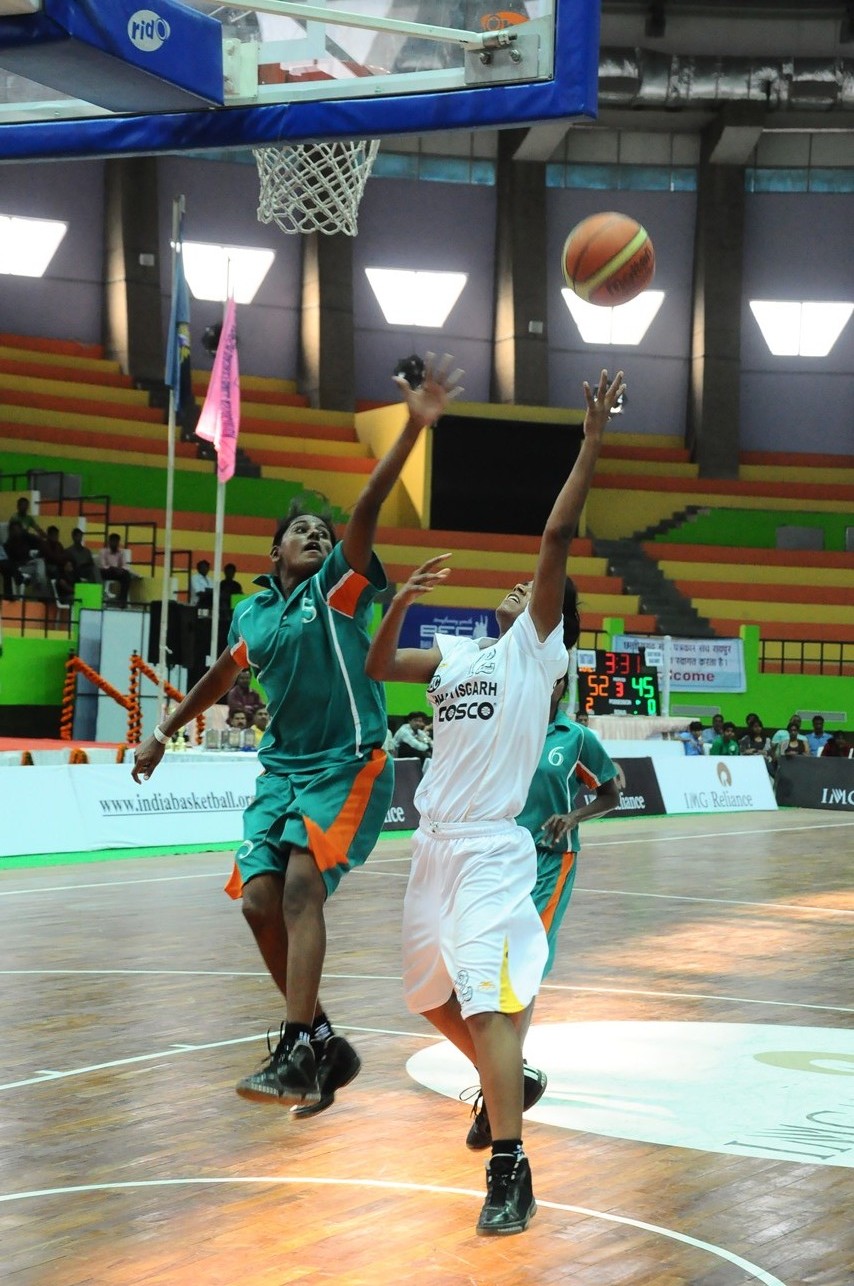
    In a thrilling and memorable conclusion to the 25th IMG-Reliance Federation Cup Basketball Championship for Men and Women in Raipur, Western Railway (Men) and hosts Chhattisgarh (Women) survived late comebacks by their opponents to lift the Federation Cup trophy on Tuesday, February 15th.

    After squandering a 14-point half-time lead to a re-energised IOB (Chennai) side, Western Railway found themselves down by one point in the final seconds of the Men’s final. It took late game heroics from Railway’s point guard Arjun Singh ‘Golu’, who hit a drive-in jumper with just three seconds left on the clock to give Western Railway a 75-74 lead and seal an emotional victory for his team.

    Behind leading scorer Vishesh Bhriguvanshi (28 points), Western Railway started off the final well, maintaining a good lead over IOB, and went into halftime up by 48-34. But they started to lose their rhythm in the third quarter as IOB began plotting a comeback. Led by the sharpshooting by Mihir Pandey, V. Mathew Revi (16), and the clutch play of international point guard Hareesh Koroth (20), IOB were on fire in the fourth quarter, barely missing a shot, and overturning an eight point deficit with five minutes to go into a one point lead in the dying seconds. It took Arjun’s game-winner in the last seconds to pull off an exciting Railway win.

    Earlier in the day, another exciting game took shape in the Women’s final, as high-flying hosts Chhattisgarh took on traditional Indian powerhouse, Southern Railway. To cope with dominating Center Geethu Anna Jose, Chhattisgarh employed a double-team defense of Seema Singh and Jose Jilna. Their tactic worked early on, as Chhattisgarh played their trademark fast-paced game and led comfortably for most of the three quarters.

    But Southern Railway began to make a valiant comeback in the final quarter, as Geethu was finally freed up from her shackles and began to find her baskets easily. As Chhattisgarh began to tire, Railway threatened to come back and steal the game away from the hosts. But their attempt was a too little too late, as Chhattisgarh survived to win 76-71. Chhattisgarh’s unstoppable twosome of Anju Lakra (22) and Pushpa M. (21) were once again the best players for their squad, whereas Geethu Anna Jose dropped 22 points for the losing side.

    The matches to decide for third-place also took place earlier on Tuesday. After losing to Chhattisgarh in the Semi-Final, Delhi Women bounced back strong against Kerala behind Prashanti Singh (23) and Asha Hedge (18) to win 70-58. Soniya Joy had 16 points for Kerala.

    In the Men’s 3rd/4th place match-up, Indian Army defeated ONGC 68-59 to seal third place. Navneet Singh led Army with 20 points and Anoop M. had 16 for ONGC.

    At the end of the tournament, Vishesh Bhriguvanshi (Western Railway) and Prashanti Singh (Delhi) won the Federation Cup’s leading scorer awards.

    Final Scores

    Men: Western Railway 75 (Vishesh Bhriguvanshi 28, Yadwinder Singh 15) bt. IOB (Chennai) 74 (Hareesh Koroth 20, V Mathew Rewi 16).
    Women: Chhattisgarh 76 (Anju Lakra 22, Pushpa M. 21, Seema Singh 13) bt. Southern Railway 71 (Geethu Anna Jose 22, Renjini Peter 15).

    Third/Fourth Place Playoffs

    Men: Indian Army 68 (Navneet Singh 20, Gopal Ram 13) bt. ONGC 59 (Anoop M. 16, Riyazuddin 15).
    Women: Delhi 70 (Prashanti Singh 23, Asha Hedge 18) bt. Kerala 58 (Soniya Joy 16).

    Leading Scorers

    Men: Vishesh Bhriguvanshi (Western Railway)
    Women: Prashanti Singh (Delhi)

    Final Standings

    Men: Western Railway, IOB (Chennai), Indian Army, ONGC
    Women: Chhattisgarh, Southern Railway, Delhi, Kerala

    Minggu, 30 Januari 2011

    Indian Railways and Southern Railway win Savio Cup 6


    In an exciting finale to eight days of mesmerising basketball at the Don Bosco–Matunga in Mumbai, Southern Railway (Women) and Indian Railways (Men) pulled off impressive victories to hoist the sixth edition of the United Phosphorous Limited (UPL) All India Savio Cup on Sunday, January 30th. Southern Railway relied on the talents of legendary Geethu Anna Jose to help beat Chhattisgarh in the Women’s final, 76-66. In the Men’s game, National Champions Indian Railways rallied behind an explosive game by Vishesh Bhriguvanshi as they pulled an improbable 91-79 upset over the strong American side, Shooting For Success (SFS).

    For his consistent dominance throughout the competition, Bhriguvanshi was named player of the tournament. Anju Lakra, the Chhattisgarh captain, took the honour in the Women’s division.

    In a tournament that has been gathering momentum and fan-following over the past few years, the Savio Cup 6 featured six Men’s teams (Indian Railways, SFS, IOB Chennai, Services, Punjab, Maharashtra) and four Women’s teams (Southern Railway, Chhattisgarh, Maharashtra, Karnataka) who played in a league system from January 23-29th, with the final held on January 30th.

    Trailing at the end of the first quarter in the Women’s final, Geethu, Anitha P., Renjini Peter, and the rest of the Southern Railway squad began to turn the game around against Chhattisgarh. Geethu led the game with 29 points while Anitha and Peter added 16 each for Railway as they won by 10 points. For Chhattisgarh, star players Pushpa M (27) and Anju Lakra (20) shined in the final.

    Undefeated thus far, American side SFS were strong favourites to win the Men’s final as they faced the Indian Railways side who had won the National Championship in New Delhi a few weeks ago. Instead, Railways kept the game close in a face-paced, back-and-forth match-up. Trailing by two at the end of the third quarter, Railways played their strongest basketball behind Vishesh 33), Yadiwinder Singh (20) and Gagandeep Singh (16) to stand as 91-79 winners. Terry Fields (29) was the high man for SFS.

    The winning teams in both divisions were rewarded Rs. 50,000 and the runners-up with Rs. 25,000.

    A dunk competition was also held on the penultimate day of the Savio Cup, which was won by Terry Fields of SFS. Amjyot Singh (Punjab) and Anwar Ferguson (SFS) finished second and third respectively.

    Final Scores

  • Women: Southern Railway 76 (Geethu Anna Jose 29, Renjini Peter 16, Anitha P. 16) bt. Chhattisgarh 66 (Pushpa M. 27, Anju Lakra 20).
  • Men: Indian Railways 91 (Vishesh Bhriguvanshi 33, Yadiwinder Singh 20, Gagandeep Singh 16) bt. Shooting For Success 79 (Terry Fields 29, David Jones 13).

    Best Players Awards

  • Women: Anju Lakra (Chhattisgarh).
  • Men: Vishesh Bhriguvanshi (Indian Railways).
  • Indian Basketball Game Tape on YouTube


    I'm a self-confessed nerd for watching basketball. I would watch it till my eyes are sore and then watch it a little more. No other factor in life has been able to wake me up consistently on early mornings except for early morning live basketball games.

    Knowing that, imagine my joy when I discovered the DVDs of all of India's Men and Women's teams' matches at the 2010 Asian Games in China! This was the first time that India had participated in the basketball tournament of the games since 1982, back when India hosted the Games. The teams didn't really return with a record to write home about (1-5 for the Men, 0-3 for the Women), but hey - at least they were there, participating against the best in Asia, playing in the awesome basketball courts in Guangzhou at such a large stage.

    So I set off on a mission to burn and upload all of the games available on the Basketball Federation of India's (BFI) new YouTube channel. Half a dozen games are already up on this channel and I will be uploading a few more over the next few days.

    As a bonus, I also ended up spending hours and hours watching the games. I have proudly become a hermit, churning out DVD after DVD of this historical tournament for Indian basketball. Yes, the game tapes are flawed: there is no commentary, the camera usually stays in one position, and apart from a couple of games, there are no scores/timings on the side of the screen. It is almost like watching the games in person, but without any of the good experiences of watching it in person.

    Still, the games make for interesting viewing. It was fun watching the likes of Vishesh Bhriguvanshi, Jagdeep Singh, Yadivinder Singh, Hareesh Koroth, and up and coming youngsters such as Dishant Shah battle out against Qatar, Chinese Taipei, Iran, Japan, Afghanistan, and Philippines. The Afghanistan game was the only one that the Men's team won, which was also a pre-qualifier to make it into the rest of the tournament. The team was led by American coach Bill Harris for this tournament. I was especially impressed by Vishesh's ever-evolving game: the young Indian captain shows a versatility between three positions and his all-round ability to score, create, rebound, and lead the team by example.

    In the Women's tapes, the likes of Geethu Anna Jose, Akanksha Singh, Anitha P., Harjeet Kaur, and Prashanti Singh show up playing against some tough Asian talent. Led in this competition by former WNBA player Tamika Raymond, the Indian dames struck unlucky with the draw, as their first two games were against Asia's finest - China and South Korea - the two teams who went on to face each other in the Final. India had a close game against Thailand but couldn't hang on in the 4th quarter against them. The Thailand game is also a great exhibition of the talents of Geethu. A legendary Center for India, Geethu's game is a feast for the eyes of any basketball lover. She is a glutton for scoring through a variety of moves in the low post, is a good rebounder of the basketball, and her most underrated skill might be her inside passing, through which she was able to make her teammates better, too.

    Once again, even though we lost a lot, and you will see more than good for India in these tapes, the attendance at the Asian Games was still a crucial step for development of basketball in India. Plus, for aspiring ball players and fans of the game in India, this is a chance to watch and learn from the best in the country in action.

    Are you excited yet? All you need is a bit of patience, maybe a set of headphones bumping your favourite music, and an average internet connection. Go and check out BFI's YouTube channel now! Over time, videos from other major basketball tournaments, if available, will be uploaded on the channel.

    By the way: a short recap of the Asian Games basketball tournament and India's performances is available here. Hosts China won gold in both the Men's and Women's divisions.

    Rabu, 19 Januari 2011

    Arjun Singh: Point Perfect


    As a chubby young child, Arjun Singh got the nickname ‘Golu’, which literally translated, means 'Round One'. As he grew older though, he left the chubbiness and roundness behind him – but it was another round thing that caught his full attention.

    The basketball.

    From the looks of it, this new ‘Golu’ in Arjun’s life is likely to stick with him forever.

    Fulfilling his potential as an explosive youth star, Arjun Singh has become one of the most respected and feared young players in India over the last few years. Still only 20 years of age, Arjun is already becoming a key ingredient of India’s senior national team. He has starred in several national and international tournaments already, and is looking to cement his position as India’s top choice at the point guard position in the future.

    Following the footsteps of his older brother, former Indian international Amit Singh, the Varanasi-boy Arjun started playing basketball when he was just 11 years old. “My brother had a serious knee injury that ended his career early,” Arjun said, “I always liked the game and used to watch my brother playing so well and winning – I knew I had to make this game my future, too.”

    Arjun began playing the game at the UP College basketball court in Varanasi, where his ascension as a basketball star mirrored another young player that started with him – Vishesh Bhriguvanshi. Arjun and Vishesh started off playing together at the same age, making it through to the UP Sub-Jr. team together, and then moving on to the Youth, Junior, and finally the Senior level. Arjun also followed Vishesh to Indian Railways, where the duo combined to make a devastating backcourt for Railways’ two of the last three years of National Championship victories.

    Arjun’s first experience to a national side was when he was called up to play for the Junior FIBA Asian Basketball Championship (ABC) back in 2008. The youngster got his first exposure of playing internationally in Tehran. He followed this with another call-up when the team went to Kuwait for the Stancovic Cup.

    Things started to get better for the youngster: Arjun, along with Vishesh, was part of the squad that won gold for India at the 1st Beach Games in Bali (Indonesia) at the 3-on-3 championship.

    2010 was an up and down year for Golu: After playing for India in the South Asian Games in Dhaka, he went on to have his best performance to date for India as the Junior ABC in Yemen neared. A good ball-handling PG for his tall height, Arjun and the Indian Junior Team dominated opponents at the Middle Asia Zone Qualifying matches held at Bangalore. His performances gained him steady crowd support too, and when India headed to Yemen for the tournament in September, he announced his arrival at the Asian stage, finishing as India’s leading scorer in a tournament that was otherwise a disappointment for the talented young team.

    “The ABC experience was great,” Arjun says, “This was the second time in this tournament for me and many of the other players. I was able to play more confidently this time. Plus our coach was Mr. Ram Kumar, who is also my coach at Indian Railways. With him on our side, I knew that the training for this tournament was going to much better.”

    Unfortunately, Arjun faced a setback at this tournament: despite his good performances, he suffered an injury that kept him out of contention for India’s Sr. Team which went on to make the country’s first appearance in an Asian Games basketball tournament since 1982.

    Arjun watched from home as India, after winning their grudge match against Afghanistan in their first game, went on to lose their next five matches against Qatar, Chinese Taipei, Iran, Philippines, and Japan. “We lost, but India played very well,” Arjun defended his fellow players, “The team lacked experience, but still played much above their level through stretches in many of the matches.”

    Arjun’s injury kept him out of the team for the Super Kung Sheung Cup in Hong Kong too, but he chose the biggest domestic stage – the National Championship – to announce his much-awaited comeback to basketball. In his second year for Indian Railways, for whom he is the starting point guard, Arjun became a fan favourite at the tournament, wowing opponents and supporters alike with his improving abilities. Indian Railways went on to win their third straight National Championship gold, defeating their rivals, Services, in the Final, 74-62.

    Arjun was in scorching-hot form in the final, scoring a game-high 27 points. Boasting an exciting line-up of Arjun, Vishesh, Gagan Deep Singh, Prakash Mishra, Yadivinder Singh, and Kiran Pal Singh, blazed through the tournament in style.

    But there is one problem that plagues Arjun despite the domestic success: many of the successful Indian players continue to get caught up in an unhealthy cycle of winning big in domestic tournaments, and then, unprepared to handle better talent, India’s national team ends up suffering internationally. “We need more exposure against better international teams before major tournaments,” Arjun said, “The Men’s team had little exposure together between the South Asian Games in January and the Asian Games in December. We can’t improve if we just keep playing against each other at home.”

    Still, Arjun remains optimistic about improvement, both for the Indian National team as well for his own game. “It will take time, but I think we are close to figuring things out,” he says, “We need to make a habit of playing and practicing together to become a stronger side. Once we can find the perfect combination of players in the team, we should be able to improve. Of course, all of us have to remain motivated and keep training harder.”

    “I want to keep improving my game, too,” Arjun adds, “Right now, I’m a good passer of the ball and can be quick running the floor. But to hang with international opponents, I have a lot more work to do. I have to add more body weight to take on stronger opponents, as well as try and get faster.”

    With a sunny future in basketball ahead of him, the boy known as Golu has come a long way at a young age. For now, his focus is on the next challenge ahead of him: the upcoming Savio Cup in Mumbai, where he will once again lead Indian Railways as the team’s premier feeder. Following that will be the Federation Cup and the basketball tournament at the National Games later in February. Railways doesn’t play in the National Games, but Arjun will be there: A highly touted player, he is wanted both by Punjab (where his current job posting is) and Jharkhand (who, as hosts, can call upon any player). His decision could well bolster one lucky side at the tournament.

    Though the young star’s ambitions, clearly, lie strongly with the National side. “I want to keep representing my country,” he says, “India’s position is down right now, so I feel that it will be my responsibility in the future to help fulfill the shortcomings we face today.”

    Minggu, 16 Januari 2011

    Indian Men's Basketball: Dream Team


    India has sent several different Men's teams to international competitions over the past year. These have included the South Asian Games at Dhaka in January, the Asian Games at Guanzhou in November, and the Super Kung Sheung Cup at Hong Kong in December. Additionally, a talented bunch of Indian youngsters represented the country at the Junior FIBA Asia Championships at Yemen in September. Of course, many fans got a chance to watch their favourite players in action for their states/clubs at the National Championship that was held at New Delhi in December/January.

    Now, with all these different squads, which have included several new omissions, players left out due to injury/behaviour reasons, or other changes, it is hard to decide what would be India's strongest Men's side.

    Fear not: what I have decided to compile here is my personal favourite pick of Indian players. If I was India's coach/selector, this is the squad of 12 I would pick to represent the country in International competitions. I have tried to pick a good blend of players with different sizes and abilities that I feel will complement each other. Also, this team should be a good blend of youth and experience - seniors to help lead the squad, players in their prime, and youngsters to provide the right kind of energy and hunger.

    My Indian Dream Team

    Starting Five
    PG: TJ Sahi
    SG: Vishesh Bhriguvanshi (Captain)
    SF: Trideep Rai
    PF: Jagdeep Singh
    C: Yadivinder Singh
    Bench
    Hareesh Koroth
    Dinesh CV
    Dishant Shah
    Arjun Singh
    Amjyot Singh
    Sambaji Kadam
    Jai Ram Jat


    As you may notice, I've picked players like Sahi and Kadam, who are now in exile from the national system, but I feel who are strong enough to still make a difference at the biggest stage.

    Here are some players who I would like to give honourable mention to: S. Robinson, Kiran Pal Singh, Prakash Mishra, Eudrick Pereira, Bobby Singh, Sunil Rathee, Ajay Pratap Singh.

    Over to you now: if you could pick your Indian Men's Dream Team, what would it be?

    Selasa, 04 Januari 2011

    BFI hands honorarium payment to players, coaches, and support staff for outstanding performance


    Press Release: The Basketball Federation of India (BFI) had recently announced that an honorarium will be paid to basketball players who are part of the country’s national system. Recently, the BFI distributed cheques of honorarium paid to Indian Basketball Players, Coaches and Support Staff for their outstanding performance during the months from October to ending December, 2010. The first three months of honorarium has been paid to 65 players, 7 coaches, and 10 members of support staff.

    List for Honorarium

    Category A

    Rs.30,000/- per month per head for their outstanding performance during the last three months i.e. October to December, 2010.

    Men

    Jagdeep Singh (Punjab)
    Yadwinder Singh (Railways)
    Trideep Rai (Uttarakhand)
    Vishesh Bhriguvanshi (Railways)

    Women

    Geethu Anna Jose(Railways)
    Anitha Pau Durai (Railways)
    Prashanti Singh (Delhi)
    Akanksha Singh (Delhi)

    Category B

    Rs.20,000/- per month per head for their outstanding performance during the last three months i.e. October to December, 2010.

    Men

    Dishant Shah (Gujurat)
    Hareesh Karoth(Tamil Nadu)
    Eudrick Preira (Kerala)
    Jay Ram Jat (Services)
    Dinesh C.V. (Tamil Nadu)
    Arjun Singh (Railways)
    Bobby Singh (U.P.)
    Amjyot Singh (Punjab)

    Women

    Raspreet Sidhu (Delhi)
    Sneha Rajguru (Maharashtra)
    Bharti Netam (Indian Railways)
    Pratima Singh (Delhi)
    Harjeet Kaur (Delhi)
    Raj Priyadarshini (Tamil Nadu)
    Jeena P.S. (Kerala)
    Kokila (Indian Railways)

    Category C

    Rs.10,000/- per month per head for their outstanding performance during the last three months i.e. October to December, 2010.

    Men

    Ajay Pratap Singh (Chattisgarh)
    Sambaji Kadam (Services)
    Harpal Singh (Gujurat)
    Harinder Singh Rathore (Rajasthan)
    Rakesh Kumar Yadav (U.P.)
    Barnet Carmel Joseph(Tamil Nadu)
    Rajan Sharma (Punjab)
    Jaskaran Singh (Punjab)
    Shadab Khan (Railways)
    Sunny Raut (M.P.)
    Anant Singh (Rajasthan)
    Kirti Goswami (M.P.)
    Sunil Kumar Rathee(Delhi)
    Shyam Sunder (Chhattisgarh)
    Lovneet Singh (Punjab)
    Harman Deep (Punjab)
    Karan Josua (Karnataka)
    B. Dinesh (Chhattisgarh)
    Abhishek Singh (U.P.)
    Kushmeet Singh (Punjab)
    Amrit Pal Singh (Punjab)
    Komal Preet (Punjab)
    Pal Preet (Punjab)
    Manpreet (Punjab)

    Women

    Smruthi Radhakrishnan (Indian Railways)
    Pushpa M. (Indian Railways)
    Madhu (West Bengal )
    Soniya Joy (Kerala)
    Reshma G. (Indian Railways)
    Kruthka Lakshaman (Karnataka)
    Amruta Bhuskute (Maharashtra)
    Kavitha (Chhattisgarh)
    Aruna Kindo (Chhattisgarh)
    Sangeetha Mandal (Chhattisgarh)
    Sangeet Kaur (Chhattisgrah)
    Preeti Kumari (U.P.)
    L. Suganya (Tamil Nadu)
    Navneeta, P.U. (Karnataka)
    Ashika Kuruvila (Karnataka)
    Anjana, P.G. (Kerala)
    Sara Vohra (Maharasthra)

    Coaches

    Rs.30,000/- per month per head for their valuable services rendered during the last three months i.e. October to December, 2010.

    Ram Kumar
    Rajinder Singh
    Sat Prakash Yadav
    S.K. Bhaskar
    Sheeba Maggon
    Prasanna Menon
    Abdul Hamid Khan

    Support Staff

    Rs.20,000/- per month per head for their valuable services rendered during the last three months i.e. October to December, 2010.

    Sudhir Rathore
    Kunjul Gada
    Nilesh Shah
    Rajeshwar Rao
    P.J. Sabestian
    Zareen Zaidi
    V. Senthilselvan
    R.S. Gaur
    Divya Singh
    Sridhar