Tampilkan postingan dengan label Bill Russell. Tampilkan semua postingan

Jumat, 28 Oktober 2011

The Super MVPs


Super MVP: A player who wins both the NBA regular season MVP and the NBA Finals MVP award in the same season.
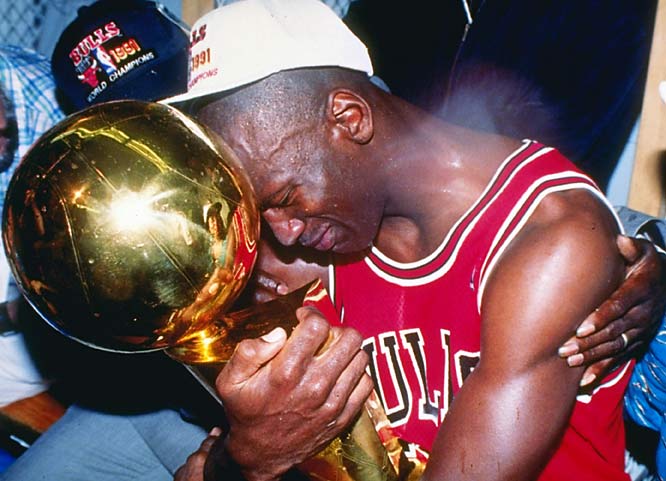
This article started in my mind several months before my fingers typed it out: it started with a discussion with my brother about the factors that define the legacies of the NBA's greatest ever players. As far as quantifiable measures go, a players' greatness can be determine by the championships he wins, the MVP awards he collects, and the statistics he posts up. Other factors such as all-star appearances, all-NBA teams, defensive player awards, and overall season/playoff games won also add to the argument.

Above all the other individual accolades that could be handed out to a player is the MVP Award. Since it was first given out to Bob Pettit in 1956, the MVP award - known as the Maurice Podoloff trophy - has been handed out 55 times to 29 players. Heralded to individual glory as this award may be, it does carry a sort of a curse with it (which I wrote about over a year ago): Only 20 times since 1956 has the NBA, MVP won the NBA Championship: only 12 players have lifted both trophies in the same season. Since Michael Jordan retired, only Shaq (2000) and Duncan (2003) have been an MVP and an NBA Champion in the same year.

Realising how difficult it is - and how much more difficult it is becoming - to win both these trophies in the same year, I have come up with a new award, handed out trademarked by the Hoopistani Blog: THE SUPER MVP. Since the 'best' player in the league, the Most Valuable Player, is thus most likely to also be the Finals MVP if his team wins a championship in the same season, this player would be that season's Super MVP.
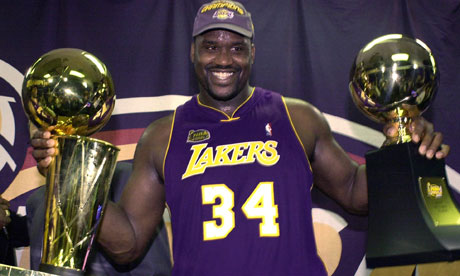
The Finals MVP award was introduced in 1969, and in that very first year, it was handed to someone who lost in the Finals: Jerry West. West averaged 38 ppg for the Lakers in a 4-3 Finals loss to - who else? - but Boston Celtics! Since then, the subsequent 42 Finals MVP awards have always gone to a champion, a trend that I hope continues to make my Super MVP award relevant.

The year 1980 was also one other curious exception to the trend. Kareem Abdul-Jabbar won the regular season MVP and the NBA Championship with the Lakers in the same season. But the Finals MVP Award that year went to a rookie Magic Johnson, who, in Kareem's injury absence, did some things which were unfathomably incredible. Sorry, but that shifts Kareem's 1980 season out of the Super MVPs list, although he does make the lineup much earlier.

The 'NBA Finals MVP Award' wasn't introduced till 1969. In 2009, Commissioner David Stern announced that he is renaming the award to honour celtics' legendary Center Bill Russell by calling it the 'Bill Russell Finals MVP Award'. That is ironic, of course, because Russell retired in 1969 without ever having won the award. Beforethis award was started, there were only five instances in NBA History when a regular season MVP won the NBA Championship in the same season. Since these players were considered to be the NBA's best for that season, and they won a championship, I'm going to assume that they count as Finals MVPs, and hence, 'Super MVPs', too.
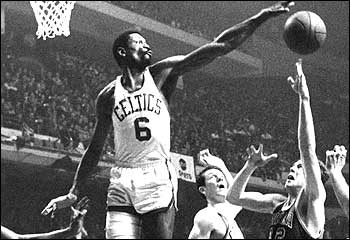
- 1957: Bob Cousy (Celtics)*
- 1961: Bill Russell (Celtics)*
- 1962: Bill Russell (Celtics)*
- 1963: Bill Russell (Celtics)*
- 1965: Bill Russell (Celtics)*
- 1967: Wilt Chamberlain (76ers)*
- 1980: Kareem Abdul-Jabbar (Lakers)**

*Won an MVP and an NBA Championship before the Finals MVP Award was introduced
**Won an MVP and an NBA Championship but not the Finals MVP Award.


And here is my list of the NBA's Super MVPs after the Finals MVP award was introduced:

- 1970: Wills Reed (Knicks)
- 1971: Kareem Abdul-Jabbar (Bucks)
- 1983: Moses Malone (Sixers)
- 1984: Larry Bird (Celtics)
- 1986: Larry Bird (Celtics)
- 1987: Magic Johnson (Lakers)
- 1991: Michael Jordan (Bulls)
- 1992: Michael Jordan (Bulls)
- 1994: Hakeem Olajuwan (Rockets)
- 1996: Michael Jordan (Bulls)
- 1998: Michael Jordan (Bulls)
- 2000: Shaquille O'Neal (Lakers)
- 2003: Tim Duncan (Spurs)

It is an impressive and exclusive collection of NBA superstars. Michael Jordan makes that list four times, and Larry Bird twice. In two occasions, Abdul-Jabbar won the MVP award and the championship in the same season, but with different teams. And before the award was introduce, it's namesake Bill Russell had an incredible four seasons where he lifted both the MVP award and the NBA Championship trophy. As the last one to achieve this feat, Tim Duncan is the honorary holder of my Super MVP award.

The rarity of being a Super MVP is what makes the feat that much more incredible. There are too many players who have a good season to win an MVP award but never add the ring to their resumes: Charles Barkley, Karl Malone, and Allen Iverson (barring his return to the NBA) are perhaps the first three names that come to my mind with the 'incomplete' legacy. A lot of former MVPs do on to become smarter players in better teams and win championships in later seasons, such as Julius 'Dr J' Erving, David Robinson, Kevin Garnett, and most recently, Dirk Nowitzki. Amongst the current crop of players, the likes of Steve Nash, LeBron James, and Derrick Rose are those who will be looking to add some championship hardware to their individual accolade.

Then, are are also many players who have never had a complete, dominating MVP season, but because of their team-play and/or their individual brilliance in the Finals, have won the championship and the Finals MVP award: John Havlicek, Rick Barry, Jo Jo White, Dennis Johnson, Cedric Maxwell, James Worthy, Joe Dumars, Isiah Thomas, Chauncey Billups, Dwyane Wade, Tony Parker, and Paul Pierce are the names who belong in this category.

So what does all this say? Considered damn-near-unanimously as the Greatest Of All Time (GOAT), Michael Jordan has also achieved the perfect combination of individual dominance and team success more often that anyone else. And if we counted those before 1969, 11-time-champ Bill Russell equals Jordan's four 'Super MVP' seasons.

And as we await the possibility of the locks to be opened for the new NBA season, and as the predictions for the champions and the MVPs pour in, I'll be keeping my eye out to see if someone can achieve the difficult combination of the two. If someone can emulate Jordan, Bird, Duncan, or Shaq for one season. If someone can finally become a Super MVP again.

Jumat, 19 Agustus 2011

Hall of The Worm


I was 11 when I first decided to give the game of basketball a chance. I wasn't very inspired and wasn't very good. I played mostly in the Ridgewood Dorm basketball court in my boarding school, a court that had some of the most unique dimensions I have ever experienced: two nine-and-half-feet high baskets, separated on a not-so-straight open court, barely two-thirds the size of a real court. The basket on one of the ends was on a tree. Yes!


But it was here that I first tried out my very limited hand in the game, and I did what every bumbling, struggling, out-of-sync newcomer does: find out that one thing that I was comfortable with, and then specialise in it. Some of the guys were great at outside shots from their hot-spots. Some were aspiring Jason Williams', focusing more on how beautiful their dribble looked than their actual shot. Some had become so familiar with the backboards that they had an uncanny and unstoppable skill of Dwyane-Wade-esque difficult layups, a skills that came especially handy when playing Air-21.


I had an awkward shot, the worst handles known to man, and little to no court vision. But I did have incredibly long arms, giving me a wingspan longer than even the boys who were taller than me. During shoot-around, we played the simple 'make it - take it' system: if you make it, you get the ball back. Otherwise, the dozen or so people standing below the basket hustle and fight for the rebound to get a chance at their own shot.


And so, my longer-than-average-arms, and the challenge to win a rebound against a dozen others against low odds, combined to gave me my first real basketball skills: rebounding. And it was during my rebounding dominant moments that some NBA-affluent friend called me a 'Worm'.


"A what?"


"A Worm. The Worm. Like Dennis Rodman."


Rodman.


I didn't know squat about the NBA beyond Magic & Michael when I first heard the name Rodman, but it wasn't going to be easy to forget him once I dug a little deeper. I found out that this cross-dressing, cameraman-kicking, hair-bleaching, strange man was also the man synonomous with rebounds. As a matter of fact, I will be shocked if Oxford made an Official Basketball Dictionary and a photograph of Dennis Rodman didn't take up the full page next to the definition of 'rebounds'.


Because Dennis Rodman, or 'The Worm' as he was nicknamed, is the greatest rebounder of the basketball in history. And now I'm going to tell you why.


A week ago, Dennis Rodman was enshrined in the Basketball Hall of Fame, a moment he capped off with one of the most emotional speeches ever given at the Hall. At only 6-foot-7 inches, Rodman constantly played bigger than his size, defending both the forward positions and the Center with ease, and playing power forward for most of his career on the offensive end. The post-merger NBA has never seen a more tenacious rebounder: Rodman led the league in rebounding an unbelievable SEVEN times, from 1992-1998! And this was in an era where he regularly went up against the likes of Hakeem Olajuwan, Charles Barkley, Shaq, Charles Oakley, Kevin Garnett, and Karl Malone.


Here was a man who averaged just 7.3 points per game during the course of his career and now finds himself in the Hall of Fame. It was his rebounding and defense that got him enshrined in the Hall, and the rebound stats in particular tell more than their share of the tale. Since 1973, no player has had a better rebounding average than Rodman, at 13.1 a game. Since 1973, Rodman owns five out of the top eight single season rebounding records, with a top two of 18.7 rpg and 18.3 rpg in 1992 and 1993 respectively. Take a look at those dates again: these otherworldy stats weren't achieved in the 'black-and-white' era of Chamberlain-Russell NBA, where the NBA only had a few taller athletic players and a fast paced to the game meant that the likes of Chamberlain and Russell got most of the rebounds available. These stats are from relatively recent years - the 90s, an era that Rodman dominated.


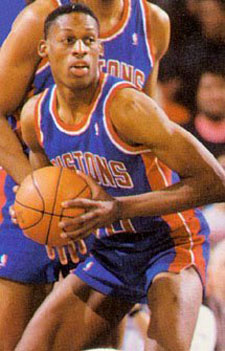
And as the old adage says, "Defense and Rebounding wins championships" - and Rodman did his fair share of winning too, getting five rings. He was the defensive heart and soul of the Detroit Pistons Bad Boys teams that won two rings in 1989 and 1990, and part of his responsibility was shutting down Michael Jordan. He spent a couple of seasons with the Spurs, where he began to stake his claim as the most dominant rebounder in the league. And as most recent history will remember him, he joined Jordan and Pippen in the legendary Chicago Bulls team for their second three-peat, winning three more championships from 1996-98.


And on a sidenote: how damn great was that Bulls team? They had the greatest player of all time, the greatest wingman/do-it-all player of all time, and the greatest rebounder of all time. The best part of the Jordan-Pippen-Rodman trio was that not only were they the teams three biggest stars, but they were the three best defenders, perhaps three of the top six or seven defenders in the league at their time.


During the course of his career, Rodman was named Defensive Player of the Year twice while with the Pistons, was an all star twice (few players not named Ben Wallace become all stars by averaging below 10 points a game), and seven times into the NBA All Defensive first team.


He did some time with the Lakers and the Mavs before calling it a day, but one of the most amusing things for me to now check up Rodman's career are the names of the teams he played for AFTER his NBA career: these include the Long Beach Jam, Orange County Crush, and Tijuana Dragons of the ABA, a team in Finland (Torpan Pojat) and in England (Brigton Bears).


On the course of his journey, Rodman did a lot of crazy shit too, and it is perhaps his extracurricular activities that made him so unpredictable off the court. Out of the large number of these activities, here are my top 3:

1) He wore a wedding dress to promote his autobiography.

2) He was a part time pro-wrestler, and fought alongside Hulk Hogan

3) He was in a movie with Jean Claude Van Damme, called Double Team. Find it: it's great! (ok, keep your expectations low)


Despite all this though, his on-court production never changed, and even at an old age, he continued to hustle hard, defend hard, rebound hard, and win rings.


And now, here is perhaps the greatest part of the Rodman story: how he fought against all the odds to become what he did. Dennis Rodman was never supposed to be the greatest ever rebounder, never supposed to be a hall of famer. He suffered an unhappy childhood, struggled through poverty and tragedy, and somehow made the NBA despite having outstanding offensive skills, and even then was a rookie at the advanced age of 25. He kept persisting, kept improving, won the rings, the DPOY accolades, the rebounding titles, and became a part of one of the greatest teams ever. And by his last title, he was already 37 years old, still reading the NBA in boards!


I didn't know these things when I was 11, when I was falling in love with the art of the rebound, when someone called me a 'worm' and I failed to realise that it was a compliment and not an insult. I added several more arsenals to my game since then, but that love for the boards never changed, and neither did my respect for Dennis Rodman. What I see now is that, 'The Worm' stood for more than just the ability to get rebounds. 'The Worm' stood for perseverance, hustle, an undying love for the game.


His career, and his life, mirror his rebounding skill. Without having the size to do it, he had the uncanny skill to break the odds and position himself for success. He jumped higher than anyone else, even those bigger and more skilled than him, to either grab the ball, or tip it away, back to himself, just like in life, he was able to tip the favours towards himself, to grab the NBA's biggest challenges by its horns. And then he would secure the rebound, just like he would secure success, and then he would do it over and over again, becoming the best at one of the most beautiful arts in basketball.

Sabtu, 04 Juni 2011

BIG: A Eulogy to Shaq's NBA Career


How's this for a (semi) oxymoron: devastatingly hilarious.

After 19 years, Shaquille O'Neal retired from the NBA. The only NBA player, or person alive, or person dead, that I can truly describe to be both - devastating, and hilarious. If I can describe him in two words, it would be those two. Not someone who was so hilarious that it almost destroyed people. Not someone who was so devastating that it was funny. No: Shaq was both those things, separately and together, in one single entity.

I heard the news seven or eight hours later than it was first announced: but this is 2011, and in the world of fast news sharing and even faster reactions, seven or eight hours is a lifetime. There was a newsletter from the NBA in my inbox, but instead of discussing the NBA Finals, the focus was all about a certain announcement by the NBA's biggest personality.

On a 16-second long video posted on Twitter, Shaquille O'Neal of the Celtics, and the Cavs before that, and the Suns before that, and the Heat, and most memorably of the Lakers, and for the Magic, announced his retirement.

The 'twitter retirement' was a surprising whimper in the story of a man who is loud, proud, boisterous, and overly Shaqtastic.

Everything about the career of Shaq has been Big. Not just Big, but BIG. It should be in bold actually. As a matter of fact, here you go: BIG. From his 7 foot 1 inch, 150 kg body to his achievements - his four championship rings, his three Finals MVP awards, his 2000 NBA MVP award, and his 15 All Star appearances. He was BIG when it came to dunking on everyone from Dikembe Mutumbo to Robert Parish, and BIG when he broke backboards on his dunks.

Now, he retires as one of the best Centers ever to play the game - and in all seriousness, I will put him in top 3, somewhere in the league with Bill Russell and Kareem Abdul-Jabbar - I'm sorry but I have never been a fan of Chamberlain. Put Shaq in the Chamberlain-era and he would've made averaging 60 and 30 look easy.

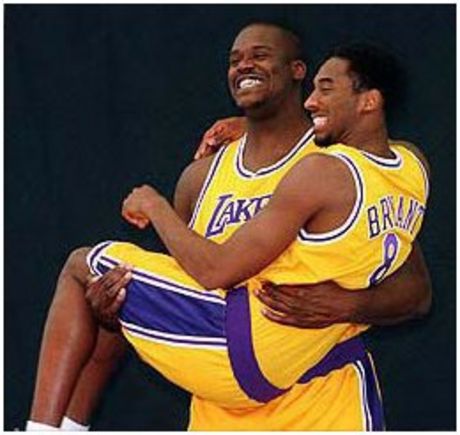
But his career to me also leaves a HUGE gaping hole and a list of questions and what-ifs - yes, I know, every player has a what if (what if MJ never left in 93? what if Grant Hill never got injured? what if the Lakers never traded for Kobe as a rookie?), but the Shaq what-if is simpler, and thus, most frustrating.

What if he cared more?

Never in his 19-year-career did Shaq play all 82 games of the regular season. His peak of dominance, where he made every other player in the league look like mincemeat, was far too short for someone with this potential. I know I'm saying this of a player, who with one trade, changed the entire balance scale of the NBA, but Shaq was THAT good. Even after a hall of fame career, I say he could've done more, could've been better. What if Shaq tried to stay in better shape? What if Shaq took the regular season more seriously? What if Shaq worked on his free throws? What if there was never any drama between him and Kobe in LA?

I read an article many years ago about how, based on pure dominance, Shaq is the man who comes closest to being the one person to change the entire shape of a franchise. Only Michael Jordan in the history of every great basketball player may rank higher. And what if Shaq had the hunger MJ had? What if he had 75 percent of that hunger? What if he tried harder and sacrificed more to keep winning. I'm convinced that he would be sitting comfortably on a couple more MVP awards, a couple more rings, and a place in NBA history as perhaps the second-best player in basketball.

Well, it's finally over now, and by most reactions, people are happy Shaq called it a day. From being the league's Most Dominating Ever (MDE) to a mere sideshow who was now more famous for his jokes and his dunks, the end of Shaq's playing career was a little too quiet.

There has been just too much about Shaq, on and off the court, to truly capture in a silly little article. I try to think about how to approach this, but the idea of Shaq, like Shaq itself, is bigger than most other NBA personalities. So I'm going to take a cop-out and list to you the many, many, MANY things that I remember about Shaq. Some you may know, some you may have forgotten, and some may be new to you - I just hope that, by the end of this list, you realise that there will never be a player who was as dominant on court and as awesome off it as Shaq again.

1. I have already mentioned this before, but Shaq broke backboards.

2. In additional to his basketball career, Shaq released four rap albums in the 90s: Shaq Diesel, Shaq Fu: The Return, You Can't Stop the Reign, and Respect.

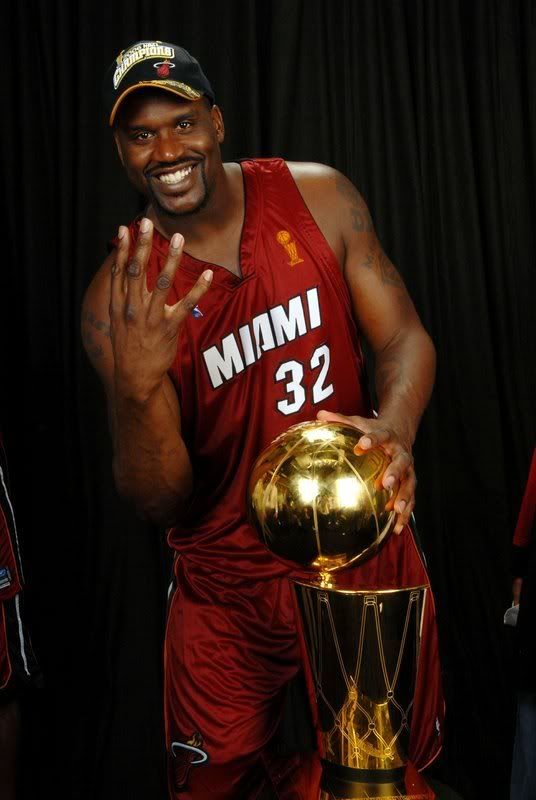
3. Shaq played for six different teams in his career, and he took THREE of them to the NBA finals - the Magic, the Lakers, and the Heat. He won with Lakers and Heat.

4. Shaq did a legendary song with another BIG - the Notorious B.I.G. - on the classic, "You Can't Stop The Reign" - "7-0, towerin inferno / invincible smooth individual / who wanna test it, foreign or domestic / no matter where you're from, I'm not the one you wanna mess wit".

5. Oh, Shaq was rookie of the year too, with the Magic.

6. Yes, Shaq did movies, of course Shaq did movies. You don't remember the classic Kazaam? Or the unstoppable Steel? What's wrong with you?

7. These were Shaq's statistics in the NBA Finals during the three-peat with the Lakers (2000-2002): 35.9 ppg, 15.2 rpg, 2.9 bpg, and 60 percent shooting. He was Finals MVP all three times.

8. Shaq has been in many music videos too, not including his own. This is very random, but I used to watch a lot of NBA Inside Stuff in the 90s, and they showed the making of a video of a little child- Aaron Carter, younger brother of Backstreet Boys' Nick Carter - of a song called "That's How I beat Shaq". No need to say more. (BTW, one of the worst songs ever). "Hey Aaron, are you for real? / One on one with Shaquille O'Neal?

9. Shaq is the fifth all-time in career scoring, at 28,596 points. He has mentioned several times that he regrets not hitting more free throws and getting higher up this list.

10. Shaq like to nickname himself, over and over again. Here is a short list (believe me, it's short): Diesel, Shaq Fu, Big Daddy, Superman (Yes, children, Shaq came way before Dwight), Big Agave, Big Cactus, Big Shaqtus, Big Galactus, Wilt Chamberneezy, The Big Baryshnikov, Dr. Shaq (after earning his MBA), Big Shamrock, Big Leprechaun, Shaqovic and Big Conductor (because he conducted the Boston Pops orchestra, obviously). He even asked fans to give him a post-retirement nickname, and settled with the 'Big 401K'. Not to mention his most recent nickname which he gave himself during the 'retirement press conference', as The Big AARP (Association for the Advancements of Retired Persons).

11. Don't be fooled by the last few years, in his prime, there was no bigger force of nature than Shaquille O'Neal. In his prime, he was one of the league's best scorers, best rebounders, best shot-blockers, and had developed his own drop-step dunk, of course, nicknamed by him, the 'Black Tornado'. To put it mildly, take Shaq 2000-2003, put him against any player in the history of the league, and NO ONE would be able to stop him. The only defense against Shaq was 'Hack-A-Shaq', aka, fouling him and forcing him to shoot free throws.

12. Shaq has a long-list of other possible work avenues besides basketball. I've already mentioned the movies and the music. In 2010 he undertook a PhD in Leadership and Education with a specialisation in Human Resource Development at Barry University. His dissertation topic was "The Duality of Humor and Aggression in Leadership Styles". Humour and Aggression - Laker leadership, anybody? Shaq is an honourary US Deputy Marshall and a Miami Beach reserve officer. He is trained in Mix-Martial Arts - boxing, jiu-jitsu, Muay Thai and wrestling. And he's on Reality TV, extremely popular with the Shaq Vs. show.

13. In 2004, when Shaq was traded to Miami, it became the biggest shift of NBA power in recent memory - he immediately made a paper thin Eastern Conference stronger. The only other players to make a big difference in the entire map of the NBA within one year in a new team have been Kevin Garnett (Timberwolves to Celtics in 2007) and LeBron James (Cavs to Heat in 2010).

14. Shaq liked to dance, and we like to watch a behemoth dance like he's Michael Jackson. Out of all of them, my favourite highlights are: 1. Shaq, LeBron, and Dwight Howard having a dance-off at the All Star Game, 2. Shaq dancing with the Jabberwockiez, and 3. Shaq challenging Justin Bieber to a dance-off.

15. Shaq played for six different teams during his career - definitely the most for any player in my 'greatest ever' list: Magic, Lakers, Heat, Suns, Cavs, and Celtics. What I liked was how, in every city, he truly embraced its culture and became a complete vocal part of the team.

16. After Kobe lost the 2008 Finals to the Celtics, Shaq went on stage at a club to sing, "Kobe, tell me how my ass taste?"

17. Only three players have won the All Star MVP, NBA MVP, and Finals MVP in the same season. They are: Willis Reed (1970), Michael Jordan (1996 and 1998) and Shaq (2000).

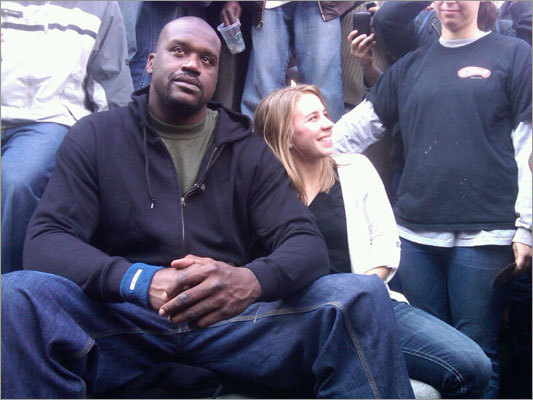
18. No, Shaq didn't play a lot in his last season in Boston, but he entertained fans in another way - posing as a statue in Boston Square, dressing up in drag on Halloween and calling himself 'Shaqueeta'.

19. I'm currently working on my list of top 25 greatest players ever, a list that takes into account a mixture of talent, peak, and overall resume. At this point, Shaq ranks 6th, only below Michael Jordan, Magic Johnson, Bill Russell, Larry Bird, and Tim Duncan.

20. It's fitting that Shaq said his goodbye via twitter. He has more followers than any other player in the NBA (3,888,667 and counting), and ranks 28th in the top list of all twitter accounts. Considering that the existence of Twitter has been parallel to the downfall of Shaq's dominance, it shows how popular Shaq is off-the-court.

But the off-the-court Shaq isn't going anywhere - if anything - he's gonna be present more - analysing NBA games, doing reality shows, making rap albums, saving the world, whatever. It is the on-court Shaq that is done, and his contribution to the NBA will be dearly missed. He is the one and only one: a personality that can be so devastating and so hilarious at the same time.

In a list of top-10 greatest players ever, there can only be 10 players. And 10 out of thousands is a very small number: very rarely will we get a chance say goodbye to someone as dominating as Shaq, but the time is here and now: So goodbye, finally, to the BIG Everything.

Senin, 18 April 2011

D12 is thrice the best on D


Most people who know my basketball opinions know that I'm somewhat of a Dwight Howard critic. I call him out on his lack of focus during clutch moments and important games. I call him out for not being the best floor leader that he should be for the Magic. I call him out for his lack of polished offensive moves, and for the fact that he just doesn't seem to be taking the competition as seriously as other elite players in the league. For long, I have maintained that the reason the man known as Superman/D12 is the best Center in the league is because there are very few Centers in the league to come in his way.

But now that my qualms about Dwight are out of the way, I can't help but maintain a grudging respect for his accomplishments. The NBA announced yesterday that Dwight Howard was named the 2010/11 Defensive Player of the Year (DPOY), and in the process, he becomes the first player in the history of the game (!!!) to be named DPOY for three consecutive seasons.

Yes! First. One. Ever. The DPOY award was introduced in 1982-83, and I have a feeling that if it was awarded earlier, a certain Bill Russell would've had his name scratched in every corner of the trophy. Nevertheless, since 83, the league has had several great defensive stalwarts (Sidney Moncrief of the Bucks won the award for the first two years), but none of them won it thrice in a row. Not Moncrief, not Michael Cooper, not Michael Jordan, not Gary Payton, Hakeem Olajuwon, Dikembe Mutombo, Dennis Rodman, Alonzo Mourning, Ben Wallace, or Kevin Garnett.

Dwight Howard!

The only people who have won the award more times are Mutombo and Ben Wallace, who each were named DPOY four times, but never more than twice in a row. Dwight won easily with 585 points, receiving 114 of the possible 120 first place votes! Kevin Garnett (77) points came second and Tyson Chandler (70) was third.

So congrats to D12 for making history. Despite the criticisms that many (including I) have been guilty of showering on him, he has continued to be the #1 in the NBA at the defensive end of the floor. Dwight led the league with 66 double-doubles this year, including six 20-20 games (!). He ranked second in rebounds and fourth in blocks. The Magic, behind Dwight, were the league's fourth best defensive team.

In a conversation that I had with my older brother just last night, we even came to the conclusion that Dwight may be the least-tradeable player in the league right now. Don't confuse that with "best player". There are few players as good as Derrick Rose, LeBron James, Kevin Durant, or Dwyane Wade, but Dwight stands above all as a unique commodity in a small man's league, bringing with him the type of game-changing potential that few players in the league possess.

Still, without an MVP or a title to his name, Dwight will always have the reputation of being almost there, just not quite. Even in this season, which was Dwight's most valuable for his otherwise inconsistent side, the big man was overshadowed by the brilliance of Derrick Rose in Chicago, who will most-likely be named MVP in a week or so.

Now, Howard needs to back up this honour and save his side from a surprise upset. In Game 1 against the Hawks, Dwight was allowed to create havoc offensively, as he scored 46 points and brought down 19 rebounds. His team-mates, unfortunately, performed a disappearing act that would've made Houdini proud. The current Magic team will never be enough to take D12 over the hump; and I believe that Dwight alone will never be the leader in a sure-shot championship team. But once you find the right type of dominating perimeter leader to team up with Howard, his teams will surely become damn-near unstoppable.

Until then, congrats, Superman. And in his honour, here's the link to my article/interview with Dwight when he came to India last August. Enjoy!